
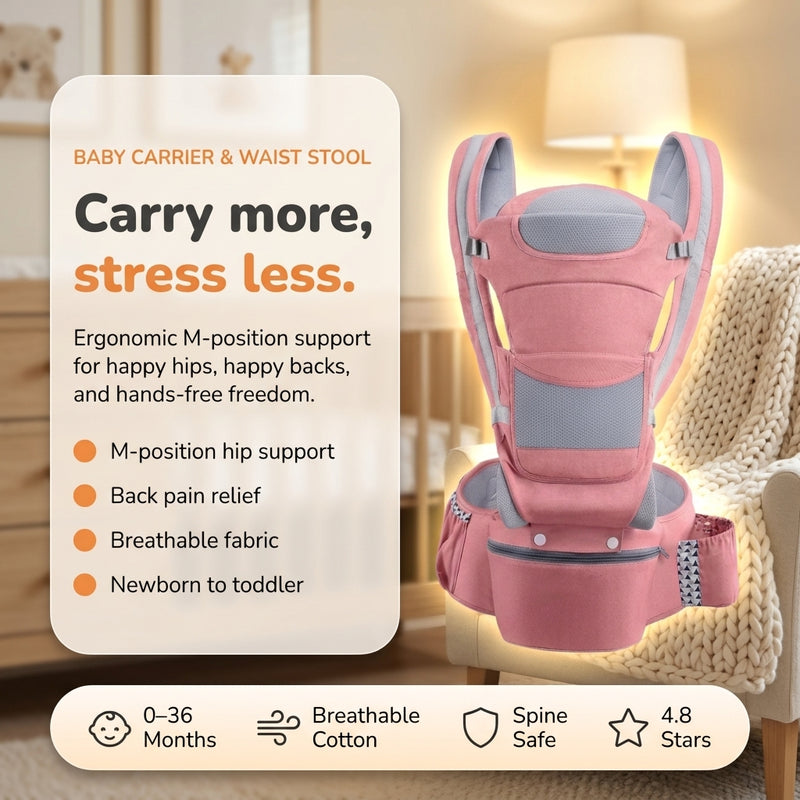


Carrier Nest - Ergonomic, Breathable, 6 Carrying Positions
Your baby only settles when you are holding them. So you keep carrying them - while your back, shoulders, and patience wear down. A carrier should make that easier, but many leave parents second-guessing the fit, the leg position, and whether baby is getting too hot. Carrier Nest is designed to make supported carrying feel simpler to check and more comfortable to keep using.
- The wide waist platform is designed to support an M-shaped seated position when adjusted correctly, helping distribute weight across the seat rather than concentrating pressure at the leg crease.
- Breathable cotton and mesh-backed panels help airflow between parent and baby for more comfortable carries.
- Multiple carry options give flexibility as your baby grows, but not every position is suitable for every baby or stage - always follow the included position guide for your baby's size, age, and development.
- The back panel is designed to help keep baby close and supported when fitted correctly.
- The waist belt helps move more load to your hips so carrying feels easier on your shoulders and arms.
You should be able to carry your baby with more confidence and less guesswork - while still checking fit and position every time.
- 1 x Ergonomic baby carrier with waist support platform
- Adjustable shoulder straps with head protection padding
- Detachable waist belt (can be used separately or with harness)
- Long back panel for sun and wind protection
- Suitability: depends on your baby's size, head control, development, and the carry position being used
- Weight capacity: Up to 50 lbs
- Parent size: Waist circumference 70-120cm (27-47 inches)
- Carry positions: Multiple positions available - always use the carry-position guidance appropriate for your baby's stage
- Material: Breathable cotton fabric with polyester lining
- Dimensions: Back panel length 38cm
- Weight: Approximately 978g-1041g depending on variant
- Care: Hand wash recommended; detachable components allow targeted cleaning
- Free shipping: Included on all Parent Nest orders, no minimum required
- 30-night trial: if Carrier Nest does not make carrying feel more manageable for your family, return it within 30 days
- Full refund: no questions asked
- Follow TICKS guidelines: baby should be Tight, In view, Close enough to kiss, Keep chin off chest, Supported back
- Always keep baby's face visible and airways clear
- Use only the carry position that matches your baby's age, size, head control, and development
- If your baby is under 4 months, premature, low birth weight, or has breathing concerns: check with your paediatrician before use
- Never carry near hot liquids, cooking, or cycling
3 Reasons Carrying Feels Harder Than It Should
Most carriers promise closeness. Fewer help parents check fit, comfort, and positioning clearly.

Narrow strap design compresses the wrong places
Most carriers are designed with narrow straps or foot openings that funnel baby's weight down their thighs and legs. Within minutes, the fabric compresses the leg crease - cutting circulation and leaving red marks when you put baby down. The brands don't flag this because most parents don't connect the red marks to the carrier.
- Red marks on baby's thighs when you take them out
- Baby unsettled after 20+ minutes in the carrier
- You stop after 30 minutes because something feels wrong

Hip joint is still forming - position matters more than most parents realise
A newborn's hip socket is still forming. Position during carrying directly affects how that socket develops. Hanging with legs dangling straight down puts the femoral head in the wrong position for healthy joint formation. Most parents don't know this until a physio or health visitor mentions it — often months later.
- Baby's legs hang straight down in the carrier
- You're unsure if the position is right
- You've Googled 'is my baby carrier safe' at least once

Heat trapping causes unsettled carries - but parents blame themselves
A sweaty, overheated baby gets unsettled fast - and parents blame themselves for the carry going wrong. Most carriers trap heat between baby and parent, especially in warmer months or indoors. The carry ends not because it didn't work, but because the temperature made it unbearable for the baby.
- Baby damp or sweaty after a short carry
- Carry only works in cooler weather
- Baby fussing earlier than you expected when using the carrier
All three causes share the same root: most carriers are engineered for closeness, not for the anatomy of the baby being held.
How Carrier Nest Makes Positioning Easier to Check

Narrow seats can concentrate pressure at the leg crease
Wide waist platform distributes weight across hips
A wider seat can help support a more even seated position when fitted correctly
Close contact can trap heat during longer carries
Breathable cotton fabric with mesh ventilation
Breathable panels can help airflow during warmer or longer wears
Poor fit can make it harder to keep baby close and supported
38cm long back panel supports natural curve
Added back support can help baby stay closer and more comfortably positioned
It can be hard to recheck fit once you're moving
Transparent ergonomic design with visible positioning
Makes visual fit checks easier while you carry
← swipe to read →
How It Works
Three simple steps to a closer, more comfortable carry.

Slip carrier on. Adjust the waist strap to your size (70 - 120cm) and shoulder harness for a secure fit. Both parents can use the same carrier without re-setting.

Place your baby into the wide padded waist stool. Their knees sit naturally higher than their bottom - the ergonomic position that protects developing hips.

Your baby is settled. Their weight is distributed across their hips and your hips, not pressing on inner thighs or your lower back. You get your hands back.
From Second-Guessing Every Carry to Easier Fit Checks
You should not have to spend the whole walk wondering whether the fit is right. When a carrier is easier to adjust and recheck, it is easier to stay present, keep moving, and carry with more confidence.

Your arms back. Your day back.
More load shifts to your hips and shoulders, so carrying can feel easier on your arms during everyday use.
More confidence in every carry
You can keep checking baby's face, leg position, and overall comfort instead of guessing once the carrier is on.
Cool enough to actually last
Breathable panels can help longer carries feel more comfortable in warmer conditions.
Problems It Fixes
Real frustrations. Simple solutions. That's what Parent Nest is built on.
Real moments. Real relief.
Carrier Nest works because it's built for how parents actually carry - not how carriers pretend we should.
Carrier Nest vs What You've Already Tried
You've probably tested these workarounds. Here's why they don't stick.

← swipe to compare →
More from Newborn


