
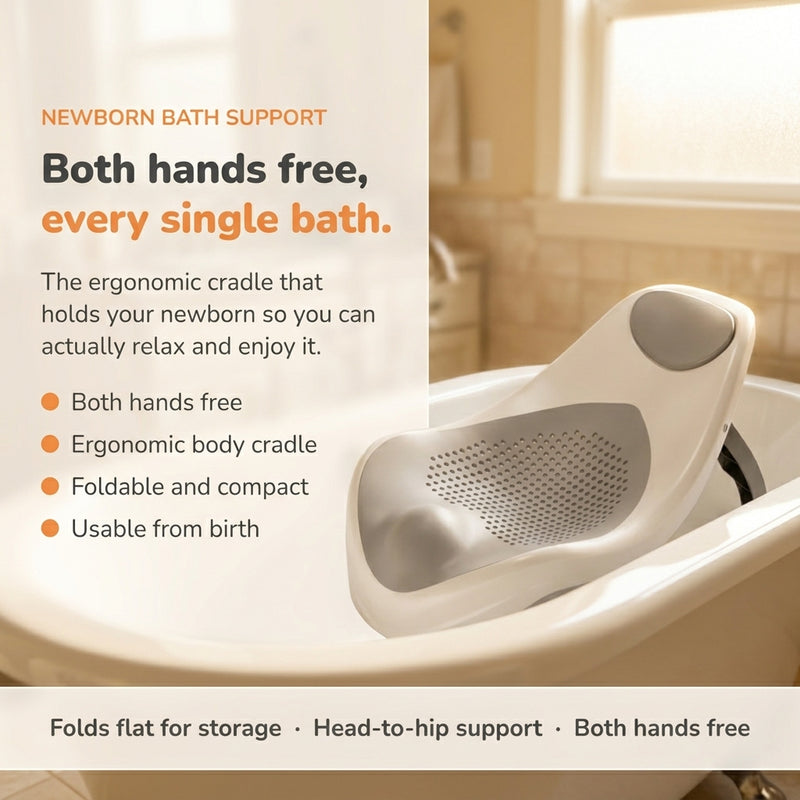


Bathe Nest - Foldable, Ergonomic Cradle, Hands-Free Support Baby Seat
Bathing a newborn can feel tense in the early weeks. Wet skin is slippery, movements are unpredictable, and it can be hard to wash calmly while still supporting your baby the whole time. Bathe Nest is designed to add extra support during supervised bath time so the routine feels more controlled and less rushed.
- The contoured cradle helps support your baby's head, neck, back, and hips during bath time, so you are not relying only on a one-handed grip.
- It helps reduce awkward repositioning, making it easier to wash carefully while you stay beside your baby throughout the bath.
- The foldable design works in many baby baths and standard tubs, with no complicated setup.
- It folds flat for easier storage between uses.
- It is intended for the early bath stage while the cradle still suits your baby's size and movement. Stop use once your baby outgrows the shape or starts pushing strongly against it.
When bath time feels more supported and predictable, it is easier to slow down and stay present.
- Bath rack x 1
- Bath stage: Intended for the early newborn and young infant bath stage while the cradle still supports your baby appropriately
- Dimensions: 52 x 30 x 15 cm
- Weight: 520g (product); 540g (packaged)
- Material: Plastic
- Free shipping: Included on all Parent Nest orders, no minimum required
- 30-night trial: if Bathe Nest doesn't make bath time feel calmer and more manageable, return it within 30 days
- Full refund: no questions asked
- WARNING: Children have drowned while using bath aids. This is not a safety device. Always keep baby within arm's reach. Never leave baby in the care of children.
- Adult supervision is required at all times - never leave your baby unattended in water, even for a second.
- Always run a short test with a small amount of water before first full use.
- Concerns about your baby's bath readiness: speak with your health visitor or paediatrician.
3 Reasons Bath Time Stays Stressful - Even After You Know What You're Doing
The problem isn't inexperience. A wet, moving newborn is genuinely hard to hold with one hand.

Wet newborn skin creates near-zero grip
There is no technique that makes a wet newborn easy to hold with one hand. Wet skin against wet skin creates near-zero friction. Every experienced parent knows this - and still feels it every bath. The grip issue isn't solved by being more careful. It's solved by removing the need to grip.
- You tense up the moment water hits the baby
- You've had the baby slip before — even slightly
- You rush to reduce the time you're holding them over water

Newborns move unpredictably — startle reflex plus kicking
A newborn's Moro reflex doesn't check whether you have a good grip first. A sudden arm fling or a kick shifts their centre of gravity instantly. With one hand on their head and one hand washing, there's nothing left to absorb an unexpected movement. The result is a lurch you catch with your wrist and a heart rate that stays elevated for the rest of the bath.
- Baby kicks mid-wash and you lose position
- You instinctively grip tighter than you mean to
- You skip washing certain areas because you can't safely move them

One hand supporting means one hand washing — badly
When one hand is permanently committed to keeping the baby's head above water, everything else is done one-handed. Lathering, rinsing, reaching the back of the neck, cleaning the nappy area - all rushed, all awkward, all incomplete. Bath time stops being a bonding moment and becomes a timed physical challenge you're glad to be done with.
- Bath feels like a workout rather than a wind-down
- You skip areas or do a poor job reaching them
- You feel relieved rather than relaxed when it's over
All three causes share the same root: one pair of hands can't safely support and wash a slippery, squirmy newborn at the same time.
From Awkward One-Handed Baths to More Controlled Support

Wet skin creates near-zero grip
Ergonomic bionic cradle supports full body
Extra support helps reduce slipping and frantic readjusting during the bath
Newborn movement shifts weight mid-bath
Full head-to-hip nest holds position
Kicks and startle reflex don't become scares
One hand supporting, one hand washing badly
Support under the body reduces awkward repositioning
Bath time feels calmer and more manageable without so much rushing
Bulky gear clutters small bathrooms
Folds flat in seconds
Stores away easily - no permanent clutter
← swipe to read →
How It Works
Three simple steps to a calmer, closely supervised bath.

Lay your baby gently into the contoured cradle and check that they look comfortably supported before starting the bath.

Use the added support to wash more calmly while keeping baby within arm's reach throughout the bath.

Rinse clean, let it dry, and fold it flat for easier storage between baths.
From White-Knuckle Grip to Calmer, More Controlled Baths
Bath time does not need to feel like a nightly stress test. When the setup feels more supportive and predictable, it is easier to slow down, stay present, and focus on your baby instead of worrying about every movement.

Washing feels less awkward
The added support can make washing feel calmer and less awkward in the early bath stage.
Kicks and startles don't become scares
Kicks and startles are still part of newborn bath time, but a more supportive setup can make them feel less overwhelming.
Bath time is the bonding moment it's supposed to be
When you are less tense, it is easier to make eye contact, slow down, and stay connected through the bath.
Problems It Fixes
Real frustrations. Simple solutions. That's what Parent Nest is built on.
Every Bath Time, Every Parent
The Bathe Nest fits into your routine from day one - no learning curve, no complicated setup.
Why the Usual Bath Time Fixes Don't Work
The problem isn't your technique. These workarounds were never designed for a slippery newborn.

← swipe to compare →
More from Newborn


