
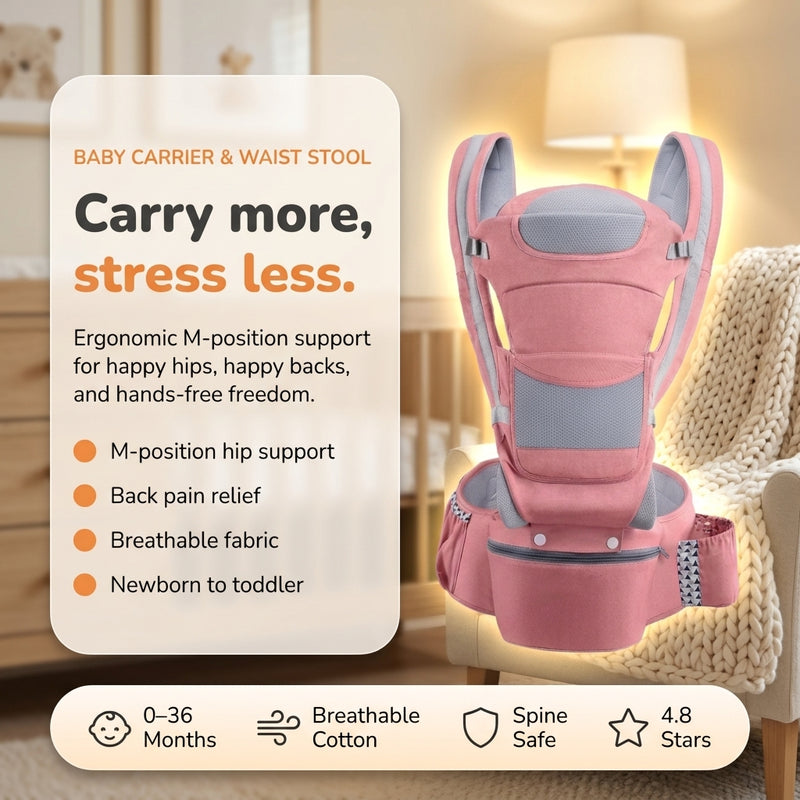


Carrier Nest - Ergonomic, Breathable, 6 Carrying Positions
Hands-free carrying without the worry. Carrier Nest distributes your baby's full weight safely across your hips, protecting their circulation, spine, and development while your hands stay free for life.
What's included
- 1 × Ergonomic baby carrier with waist support platform
- Adjustable shoulder straps with head protection padding
- Detachable waist belt (can be used separately or with harness)
- Long back panel for sun and wind protection
Good to know
- Age range: Newborn to 48 months (0–4 years)
- Weight capacity: Up to 50 lbs
- Parent size: Waist circumference 70–120cm (27–47 inches)
- Carrying positions: 6 positions including single shoulder, dual shoulder, horizontal hold, and back carry
- Material: Breathable cotton fabric with polyester lining
- Dimensions: Back panel length 38cm for full spinal support
- Weight: Approximately 978g–1041g depending on variant
- Care: Hand wash recommended; detachable components allow targeted cleaning
- US delivery: Approximately 9 days from order
- Free shipping: Included on all Parent Nest orders, no minimum required
3 Reasons Carrying Feels Unsafe — And Why Your Worry Is Valid
Most carriers are designed for closeness. Few are designed around your baby's actual anatomy.

Narrow strap design compresses the wrong places
Most basic carriers use narrow leg openings or strap-through designs that place upward pressure directly against the soft tissue of the inner thigh and groin. In newborns and young infants, this tissue is extremely soft and compressible. Pressure doesn't need to be extreme to restrict blood flow — it just needs to be consistent. A baby who can't communicate discomfort or numbness can sit in a compromised position for a long time without a visible sign until you remove them and see the marks.
- Red or pale marks on inner thighs after removing from carrier
- Baby becomes fussy or stiff-legged during longer carries
- Legs hang straight down rather than in a natural bent-knee position
- Baby seems fine in carrier but unsettled immediately after removal

Hip joint is still forming — position matters more than most parents realise
At birth, the hip socket is largely cartilage and does not fully harden into bone until well into toddlerhood. The position in which a baby spends significant time during this window affects how the socket develops. When a carrier allows the legs to hang straight down — pulling the femoral head out of the socket — rather than seated in a bent-knee, spread-squat position, it places the joint under the wrong kind of load. This isn't about one bad carry. It's about the cumulative position across dozens of carries during the months when the hip is most malleable.
- Baby's legs hang vertically rather than in a frog-leg squat
- Carrier has no structured seat — baby's weight goes through the crotch
- Leg openings force the thighs inward rather than apart
- Limited hip range of motion when lying flat [Needs CJ verification — recommend flagging to parents to discuss with their paediatrician]

Heat trapping causes unsettled carries — but parents blame themselves
When a baby is pressed against a parent's chest in a non-breathable carrier, the combined body heat of two bodies has nowhere to go. Infant core temperature rises faster than adult temperature because their surface-area-to-body-mass ratio is much higher. A baby who is overheating will signal it through fussiness, redness, and pulling away — but parents often interpret this as the baby not wanting to be carried, rather than the carrier being the problem. The result is shorter carries, more manual holding, and more exhaustion for the parent.
- Baby becomes red-faced or sweaty within 10–15 minutes of being carried
- Fussiness increases progressively during the carry, not at the start
- Baby settles immediately when removed from carrier on warm days
- Redness concentrated where fabric presses most tightly against skin
All three causes share the same root: most carriers are engineered for closeness, not for the anatomy of the baby being held.
How Carrier Nest Fixes What Other Carriers Hide

Pressure on baby's thighs cuts circulation
Wide waist platform distributes weight across hips
Zero compression on baby's legs, no marks, healthy circulation
Heat trapping causes rash inside the carrier
Breathable cotton fabric with mesh ventilation
Skin stays dry and cool, no heat rash, comfortable for hours
Unsupported spine collapses posture
38cm long back panel supports natural curve
Spine stays aligned, better posture habits, safe through toddler years
You can't verify your baby is positioned safely
Transparent ergonomic design with visible positioning
You can see exactly how baby is positioned at all times
← swipe to read →
How It Works
Three simple steps to carrying that actually feels safe.

Slip carrier on. Adjust the waist strap to your size (70–120cm) and shoulder harness for a secure fit. Both parents can use the same carrier without re-setting.

Place your baby into the wide padded waist stool. Their knees sit naturally higher than their bottom — the ergonomic position that protects developing hips.

Your baby is settled. Their weight is distributed across their hips and your hips, not pressing on inner thighs or your lower back. You get your hands back.
From Checking Their Legs Every Five Minutes — To Just Getting On With Your Day
You shouldn't have to audit your carrier every time you wear it. The anxiety of wondering if your baby is okay in there is its own kind of exhaustion — on top of the exhaustion you're already carrying. Carrier Nest was built so that the safety is built in, not checked in. You put it on. Your baby settles. You move. That's how it was always supposed to feel.

Your arms back. Your day back.
When your baby will only settle in arms, everything else stops. The waist stool changes that equation — they're held, they're settled, and your hands are free. Dinner gets made. The toddler gets read to. You stop choosing between your baby and everything else.
Safety you don't have to think about
The leg marks, the circulation worries, the hip position anxiety — they're all addressed in the design itself. You don't need to check. You don't need to Google at 2am. The seat does what it's supposed to do, and you can trust that.
Cool enough to actually last
Short carries because the baby overheats are just as exhausting as no carry at all. The breathable construction means carries that actually run their full course — so your baby settles properly, not just partially.
Problems It Fixes
Real frustrations. Simple solutions. That's what Parent Nest is built on.
Real moments. Real relief.
Carrier Nest works because it's built for how parents actually carry — not how carriers pretend we should.
Carrier Nest vs What You've Already Tried
You've probably tested these workarounds. Here's why they don't stick.

← swipe to compare →
More from Newborn


